

- By Yash Kuchhal — Founder & CEO, Apricorn Solutions
- APP Development
- Published:
- Last Updated:
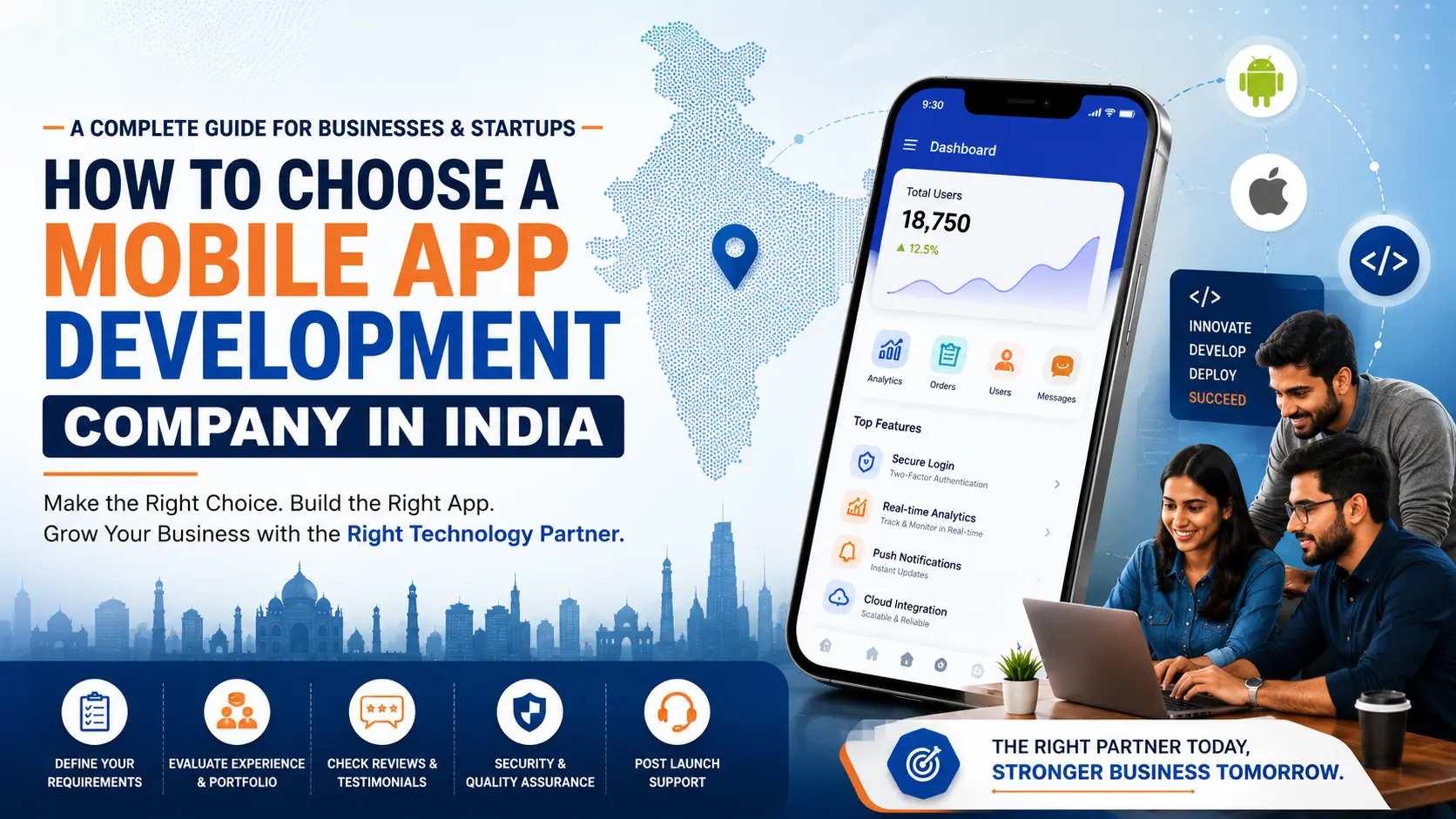
How to Choose a Mobile App Development Company in India
One of our friends invested a lot of time and money into creating an app, only to find out that the back-end of his app only allowed for a few hundred concurrent users at launch. The front side of the app and the idea both checked out. The team he hired was not a good fit. Working with Indian Mobile App Development companies is really about understanding your users and your business, post the first line of code.
Designing an app and fulfilling many of the business goals requires a lot of UI/UX, appropriate technology selection, ensuring your data is secure, rigorous testing, timely deployment, and a lot of effort post-deployment that requires ongoing work for many years. Selecting the right app development company in India is therefore important, as choosing the wrong partner will burn a lot of time and money and will be disastrous for the idea. Businesses also need to consider factors such as website development cost in India 2026 and mobile development cost in India 2026 when planning their overall digital investment. This article guides you through what you need to consider when evaluating potential partners for your app development project.
Why Choosing The Right Mobile App Development Company Is So Important
When developing a mobile app, there are situations where the costs and effects of a bad hiring decision will not become apparent until it is too late. More often than not, companies discover the costs and effects of a bad decision, and they are often pernicious, catastrophic, and impossible to correct. Some of these examples are delays in releasing your app due to development companies utilizing unrealistic timeframes, user data and payment data security breaches because insufficient security measures were employed, user data frustration and attrition due to poor app navigation, code complexity which the original developers are the only ones who can understand, app development costs exceeding your budget, and poor app performance. All of these examples are secondary effects of poor app development. By employing the right Mobile App Development Company, they allay your concerns by building custom code, leaving you updated throughout the process, and providing support after the app is launched.
The 10 Things You Need To Consider When Choosing The Best Mobile App Development Company In India
1. Their Experience and Technical Expertise
Due to their knowledge of Android, iOS, Flutter, React Native, native app development, APIs, back-end, DB, cloud development, AI, etc., they know that saying “they’ve worked with” a specific technology doesn’t necessarily equate to having experience with shipping apps that utilize the technology and increase the level of app complexity with each subsequent app released. A team that works on informational apps is unlikely to be suited to build a complex, high-volume, real-time application. Make sure they have the relevant skills for your App.
2. Assess Their Portfolio and Past Work
A portfolio is usually an excellent source of information. It is more useful than a standard sales contract. Carefully examine their portfolio. See if they have some prior industry-relevant experience. Look at the level of intricacy of the apps and examine the UI/UX, app performance, and consider the execution of the planned features. Do a subjective assessment of the apps.
10 simple apps do a lot less than the one complex app built after considerable thought.
3. Client Feedback and Testimonials
Client reviews and testimonials are just as important to us as third-party review sites (such as Clutch) that they cannot manage, and most importantly, Google reviews. Case studies are of great importance, but long-term relationships trump all one-off projects.
1. Read Reviews
You can ignore the one- or two-sentence five-star reviews. The reviews that cover their communication, delivery time, the improvements they made, and the support they offered after launch are the more helpful reviews.
2. Evaluate Their Tech Stack
Choosing a good tech stack is important. You should be educated on your options. Look into lesser-known tech stacks and evaluate them. You should also research SaaS tools that support DevOps.
3. Read Case Studies
Stories are memorable. Case studies tell stories. You should read all the case studies that your potential vendor has to offer. You will often find that a case study will have all the information that you need on a project that is heavily redacted. They will tell you how those vendors supported the client during the project. Be sure to research the case studies that the vendors provide and note how their outcomes sound.
4. Understand Their Development Process
The development process will be an iterative effort that includes the following phases: requirement gathering, planning, designing, building, testing, deploying, and providing after-support. Provide them with your request to present the entire process and the materials that they will provide you (wireframes, test cases, etc.) during each phase. Their process will need to include support for the entire system.
5. Understand UI/UX
Design fails not because of poor functionality, but because of poor UI/UX. Research how users move through the application. Find out how they wireframe and design. Check if the design team is able to support both good UI and good UX.
6. Think About the Price
The lowest priced project quote is the one you should eliminate first. The difference in the project quote can mean the difference of hundreds of thousands of dollars. The cost differential can be caused by the number of platforms being targeted, the number of complex screens, the number of complex features and interactions, the backend complexity and APIs, testing, and maintenance.
Cost quotes will vary. When reviewing vendor quotes, always ask them to break down the cost for each feature. You will quickly determine if the team is efficient or not and if they are quoting a competitive price.
7. Evaluation of Communications and Project Management
Common issues in project management involve communication; however, one can identify an assignment as project management (PM) work by defining how often status/progress meetings will be, the reporting format and tools, and how communication will be used to resolve multiple competing requests.
Other questions include, “Who do I contact for high-priority matters, and how do you ensure you document all important decisions?”
8. Testing and Quality Assurance
During QA, testing should occur throughout a process and should include functional, non-functional, performance, and numerous other kinds of testing, including security, device, usability and accessibility, and testing. Testing should be most integrated with the development and DevOps processes to minimize potential issues.
9. Security and Data Protection
Applications that retain customer data including payment data and data of customer accounts must meet the adequate protection requirements. Risks concerning secure authentication, API, database, and payload protection along with data protection, as well as other control will be addressed.
The level of protection a system will require may depend on the field, data type, and location. Therefore, it is highly advisable to carry out the necessary investigations into the Indian laws applicable to the specific app before making any conclusive remarks.
10. Analyze Post-Launch Support and Maintenance
Launching your app is only the beginning. You have to look at what a company will do about bug fixes, updates for the OS, security patches, performance upgrades, new features, server maintenance, and supporting your app on the App/Play Stores. A company with a bad plan for maintaining your app will make you feel like you need to fix it yourself six months after launch.
Sample Interview Questions for Mobile Application Developers
1. What are some applications you have developed? Please show me some examples.
2. How would you design the technical portion of my application?
3. How would you distribute your resources? Would you dedicate a development team to my application?
4. Would you give my application a dedicated project manager?
5. How much do you think this would cost? What are the project expenses that you will not charge me for?
6. How long do you estimate development will take? Will you give me a buffer?
7. How do you plan to deal with change requests?
8. What does your testing procedure look like? What will you be testing?
9. Who will own the source code and IP once the project is complete?
10. What does your post-launch support look like?
11. Who will control the requests for updating the app?
12. How will you secure the app while we develop it?
13. How will you keep me updated on the progress each day, and what will your communication look like?
14. What would you consider a low quote?
No contract. No deal. No project definition. No scope.
You know a project is doomed when a stakeholder says they can build a very complex app in a very short time.
After their first couple of meetings, you begin to understand how critical your project is to them.
There is no defined scope for testing. Expect a buggy product.
There is no planned support after launch. What are your plans for protecting and supporting your product while development is in process?
Make sure you reach an agreement on the source code document ownership before starting your project.
There are definitely going to be hidden costs. Be careful what costs you incur, because the project sponsor is not going to pay for everything.
No contract? No documents? The two of you are at risk and unprotected should something happen.
Be informed; a contract should be expected, and your development team should support you on this.
How Much Does It Cost To Make An App In India?
A custom software app comes at a cost, and there will never be two apps built exactly the same way. When you talk to possible development partners, they should be providing you with base costs for their services.
Developing a mobile app in India should cost between one and a half to twenty five lakhs rupees depending on factors such as app functionality, design, technology, integrations, the number of development team members, and namely more complex apps requiring advanced security, real time tracking, AI, and APIs, which, of course, increase costs.
Keep in mind that when you're looking to hire an Indian app development company, you should request that they provide you with a holistic quote that includes all costs associated with UI/UX design, development, testing, launch, and ongoing app support and maintenance. That way, there will be no surprises for you in your project proposal budget.
Case Study: Choosing the Right Development Approach for a Growing Business
Business Challenge
An Indian retail business initially fulfilled orders via a limited Web and phone-based order fulfillment system. When order volume outgrew manual processing, the retail business struggled to fulfill orders.
Requirement
The business was seeking to build an app that would allow customers to register, browse and search products, place orders, and make payments, all within the app. The customers should also be able to receive notifications, use an admin dashboard, and perform simple analytics.
Selection Process
The business selected the most relevant mobile app development company from a list of three mobile app development companies operating in India. While making the selection, the three mobile app development companies were assessed based on tech stacks and portfolios, how they communicate, their process, security, testing, support, and costs.
Development Approach
Developers agreed that the app's development and system maintenance balance should be taken into consideration when determining the development approach taken for the app, and the most common technology stack should be avoided.
Result
The business client fully automated their order and booking systems and improved customer engagement and user experience while simplifying administration.
Lesson
Price should not be the only consideration when choosing a development partner. Fit and communication should be prioritized just like price.
Not All Indian Cities Evaluate Development the Same Way
When choosing a development partner, convenience gets noticed, but there are other factors to consider. Whether you consider partnering with an app development company in Bangalore or a web development company in Pune is a good starting point. Location should never be the only consideration. Factors like experience and pricing will always be the same irrespective of location. Distance should not be a decisive factor. A company should always assess the capabilities of a potential development partner.
Last-Minute Checklist When Choosing An App Development Company
Evaluating a company's development portfolio is an excellent place to start. However, I want to take this evaluation to the next level with this list. Having a project scoped with price and a time frame is essential. A company should aim for usability and security with both the products used and developed. Also, the company should retain ownership of the code and have the ability to make changes to the product after launch.
Conclusion
Treating a partnership with a mobile app development company in India as a long-term partnership is the right approach. Choosing a partner based on the minimum bid is always the wrong approach. Bad quality work and long service times without support and security after the app is launched will be justified by poor proposals. The right partner is one who has a deep understanding of your business and app needs for a minimum of three years.
In your app evaluation period, it's usually advised to have a detailed conversation about your app idea before agreeing to any proposal. A short conversation with a development team can help you understand the scope and cost of your idea, and even give better methods than a proposal will.