

- By Yash Kuchhal — Founder & CEO, Apricorn Solutions
- seo
- Published:
- Last Updated:
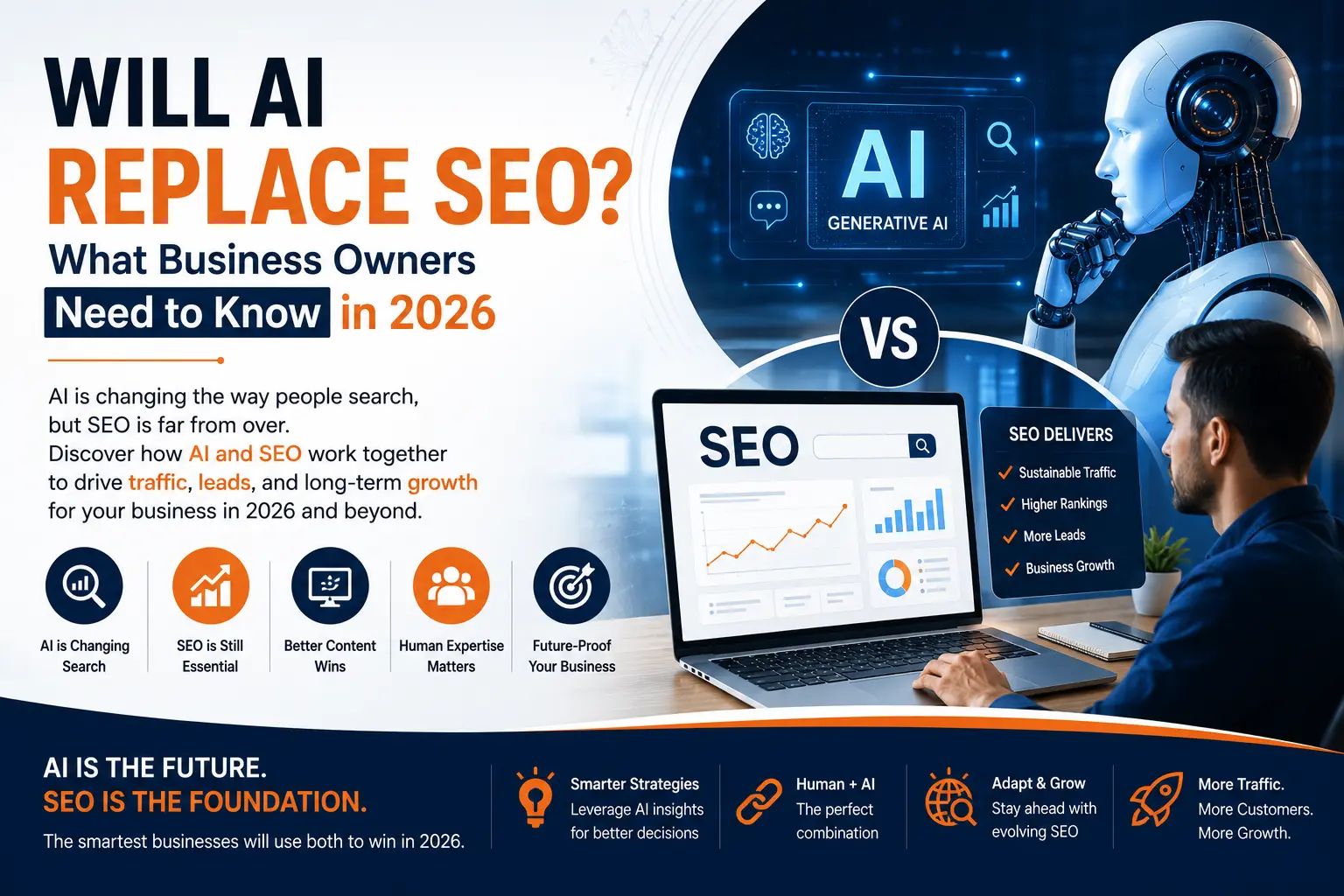
Will AI Replace SEO? What Business Owners Need to Know in 2026
No, AI will not replace SEO in 2026-2027. Instead, search is evolving from traditional keyword matching to AI-assisted answer engines (AEO). Websites optimized for technical depth, unique first-party data, and entity authority will continue to dominate.
If you run a business and you've spent any time on LinkedIn or in marketing forums lately, you've probably seen the panic. "SEO is dead." "ChatGPT killed Google." "Nobody needs websites anymore."
It's easy to understand why people are worried. Tools like ChatGPT, Gemini, Claude, and Perplexity have changed how millions of people search for information. And Google's AI Overviews now answer many questions directly on the search results page, before a person even clicks a link.
So business owners are asking a fair question: Will AI replace SEO?
Here's the short answer: No, AI will not replace SEO. But it is changing how SEO works, and businesses that don't adapt will fall behind.
This isn't the end of SEO. It's the next chapter. And in this guide, we'll walk through exactly what's changing, why it's happening, and what you should do about it right now.
Understanding the Rise of AI Search
To understand where SEO is headed, it helps to understand how search itself is changing.
Traditional search worked like this: you typed a query into Google, and you got a list of ten blue links. You clicked the ones that looked relevant, compared a few pages, and found your answer.
AI-powered search works differently. Instead of just listing links, AI tools read through multiple sources, pull out the key information, and generate a direct answer in plain language.
A few examples of this shift:
- Google AI Overviews now appear at the top of many search results, summarizing information from several websites into one answer box.
- ChatGPT Search lets users ask questions conversationally and get answers with cited sources, similar to a knowledgeable assistant rather than a search engine.
- Perplexity AI is built entirely around giving direct, sourced answers instead of a list of links.
- Gemini's search experience integrates Google's AI directly into the search and browsing experience, often summarizing entire topics in seconds.
These tools don't eliminate websites. They depend on them. Every AI answer is built from content that already exists somewhere on the web — which is exactly why SEO still matters.
Why Many People Think AI Will Replace SEO
The fear isn't irrational. There are real reasons people believe SEO is becoming obsolete.
AI Gives Direct Answers
When someone asks "What's the best CRM for a small business?" and gets a full answer right there in the search results, they may never click through to a website. That feels like a direct threat to traffic.
Less Need to Visit Websites
Studies on "zero-click searches" have shown that a growing share of searches end without a click to any website at all. If people get their answer without visiting your site, what's the point of ranking?
AI Can Generate Content Quickly
Anyone can now type a prompt and produce a 1,000-word article in seconds. This has flooded the internet with content, making some business owners wonder if quality writing — and the SEO work behind it — even matters anymore.
Search Behavior Is Changing
People are searching differently. Instead of typing short keyword phrases like "best plumber Gurgaon," they're asking full questions: "Who is the most reliable plumber near me with good reviews?" That shift changes what content needs to look like.
All of these trends are real. But none of them mean SEO is disappearing — they mean it's transforming.
The Truth — SEO Is Evolving, Not Dying
Here's what the panic misses: AI search engines still rely on the same foundation that traditional SEO was built on — trustworthy, well-structured, helpful content.
AI Still Needs Quality Content
Every AI Overview, every ChatGPT answer, every Perplexity summary is generated from existing web content. If your website doesn't exist, isn't optimized, or isn't trustworthy, AI tools have nothing to pull from — and won't mention you.
AI Relies on Trusted Websites
AI models are trained to prioritize authoritative, well-sourced information. Generic, thin, or unoriginal content gets ignored. This actually raises the bar for SEO quality rather than lowering it.
Search Engines Still Rank Web Pages
Even with AI Overviews, Google still shows traditional search results below or alongside them. Ranking well in classic search results remains essential — and it's often the source material AI pulls from.
User Intent Still Matters
AI tools are good at understanding intent, but they still need content that actually answers the question clearly. Pages that match search intent precisely continue to perform better, in both traditional and AI search.
Technical SEO Remains Important
Site speed, mobile-friendliness, secure connections, clean code, and proper indexing are still required for any search engine — human-facing or AI-facing — to crawl, understand, and trust your site.
As one digital marketing consultant put it during a recent industry panel: "AI didn't remove the need for SEO. It removed the patience for bad SEO."
How SEO Will Change in 2026 and Beyond
SEO isn't vanishing — it's branching into new disciplines. Here's what's becoming essential:
- Answer Engine Optimization (AEO): Structuring content so AI tools can easily extract clear, direct answers to specific questions.
- Generative Engine Optimization (GEO): Optimizing content specifically to be cited and summarized by generative AI tools like ChatGPT and Gemini.
- Entity-Based SEO: Helping search engines understand who you are, what you do, and how you relate to other trusted entities — not just which keywords you use.
- Brand Authority Building: AI tools favor recognizable, credible brands over anonymous websites with no reputation.
- E.E.A.T Signals: Experience, Expertise, Authoritativeness, and Trustworthiness are more important than ever, since AI tools are trained to filter out low-quality sources.
- Topical Authority: Covering a subject thoroughly, across multiple connected pages, rather than publishing one-off blog posts.
- Structured Data and Schema: Markup that helps both traditional and AI search engines understand your content's structure and meaning.
- User Experience Optimization: Fast load times, clear navigation, and mobile usability remain ranking factors that AI tools also reward.
What Business Owners Should Do Right Now
Here are concrete steps you can take today:
- Build brand authority — get featured in press, reviews, and industry directories.
- Create expert content — written or reviewed by people with real experience in your field.
- Optimize for AI search — structure content with clear headings and direct answers near the top.
- Improve website speed — slow sites lose both rankings and visitors.
- Focus on E.E.A.T — show credentials, author bios, and real business information.
- Publish case studies — real results build trust that generic content can't.
- Create FAQ content — directly answer the questions your customers actually ask.
- Invest in local SEO — especially important for service businesses with a physical location or service area.
- Strengthen technical SEO — fix crawl errors, broken links, and slow-loading pages.
- Build trust signals — reviews, testimonials, certifications, and transparent contact details.
If you're a local service business — say, an SEO company in Palwal or an SEO company in Gurgaon — these fundamentals matter even more, because local search results are increasingly shaped by trust and proximity signals that AI tools also rely on. The same applies to businesses working with an SEO company in Rewari or an SEO company in Dadri: local authority and consistent business information across the web are now baseline requirements, not bonus points.
AI + SEO = The Winning Combination
The smartest businesses aren't choosing between AI and SEO. They're using both.
AI tools are excellent for:
- Keyword research — quickly identifying search trends and related terms
- Content outlines — structuring articles faster
- Competitor analysis — spotting gaps in competitor content
- SEO audits — flagging technical issues at scale
- Content optimization — suggesting readability and structure improvements
But here's what AI cannot replace:
- Human expertise — real industry knowledge and firsthand experience
- Strategy — knowing which battles are worth fighting for your specific business
- Creativity — original ideas that stand out instead of blending in
- Brand storytelling — the human voice that builds genuine connection with customers
AI is a tool. It's not a strategist, and it's definitely not your brand.
Case Study — How a Local Business Increased Organic Leads Using AI + SEO
Business Type: A local home services company offering repair and maintenance work.
The Challenge: After Google rolled out AI Overviews more broadly, this business saw organic traffic decline. Fewer people were clicking through from search results, and lead volume dropped along with it.
The Strategy:
- Rewrote core service pages to directly answer common customer questions near the top of each page
- Added a detailed FAQ section to every major service page
- Strengthened E.E.A.T by adding technician bios, certifications, and years of experience
- Used AI tools to research competitor content gaps and generate first-draft outlines, which were then rewritten and fact-checked by the team
- Implemented schema markup for services, reviews, and FAQs
- Doubled down on local SEO — updated business listings, gathered fresh reviews, and built location-specific content
Results After 6 Months:
- 120% increase in organic traffic
- 85% increase in qualified leads
- Higher visibility in AI-generated search summaries, including mentions in Google's AI Overview for several service-related queries
- Noticeably improved local map pack rankings
Lesson learned: The business didn't fight against AI search — it adapted to it. By making content clearer, more trustworthy, and easier for both humans and AI to understand, they turned a traffic decline into measurable growth.
Common Mistakes Business Owners Should Avoid
- Publishing AI content without editing — unedited AI text often sounds generic and lacks real expertise
- Ignoring E.E.A.T — skipping author info, credentials, and trust signals
- Neglecting technical SEO — slow sites and broken links undermine everything else
- Keyword stuffing — outdated tactics that hurt readability and rankings alike
- Not optimizing for AI search — failing to structure content for direct-answer formats
- Relying only on ChatGPT-generated articles — without human review, fact-checking, or original insight
Future Prediction — What Will SEO Look Like in 2030?
Looking ahead, a few trends seem likely to define the next phase of search:
- AI-assisted search will become the default way most people find information online
- Personalized results will tailor answers based on user history, location, and preferences
- Voice search will keep growing as smart assistants become more conversational
- Brand authority will matter more than ever, since AI tools favor recognizable, trusted names
- SEO professionals will increasingly function as search strategists, managing visibility across traditional search, AI engines, voice assistants, and beyond
The core skill set is shifting from "ranking for keywords" to "becoming the trusted source AI tools choose to cite."
Conclusion
AI is transforming SEO — but it isn't replacing it. Search engines, AI tools, and chatbots all still depend on real websites with real expertise behind them. The fundamentals of trust, quality, and relevance haven't gone away. They've just gotten more important.
Businesses that combine smart use of AI tools with strong, human-led SEO strategy will dominate search results — both traditional and AI-generated — in the years ahead. The winners won't be the businesses that publish the most content. They'll be the brands that consistently provide real expertise, earn genuine trust, and deliver clear value to the people searching for them.
If you want your business to stay visible as search keeps evolving, now is the time to invest in future-ready SEO — not abandon it.