

- By Yash Kuchhal — Founder & CEO, Apricorn Solutions
- Software Development
- Published:
- Last Updated:
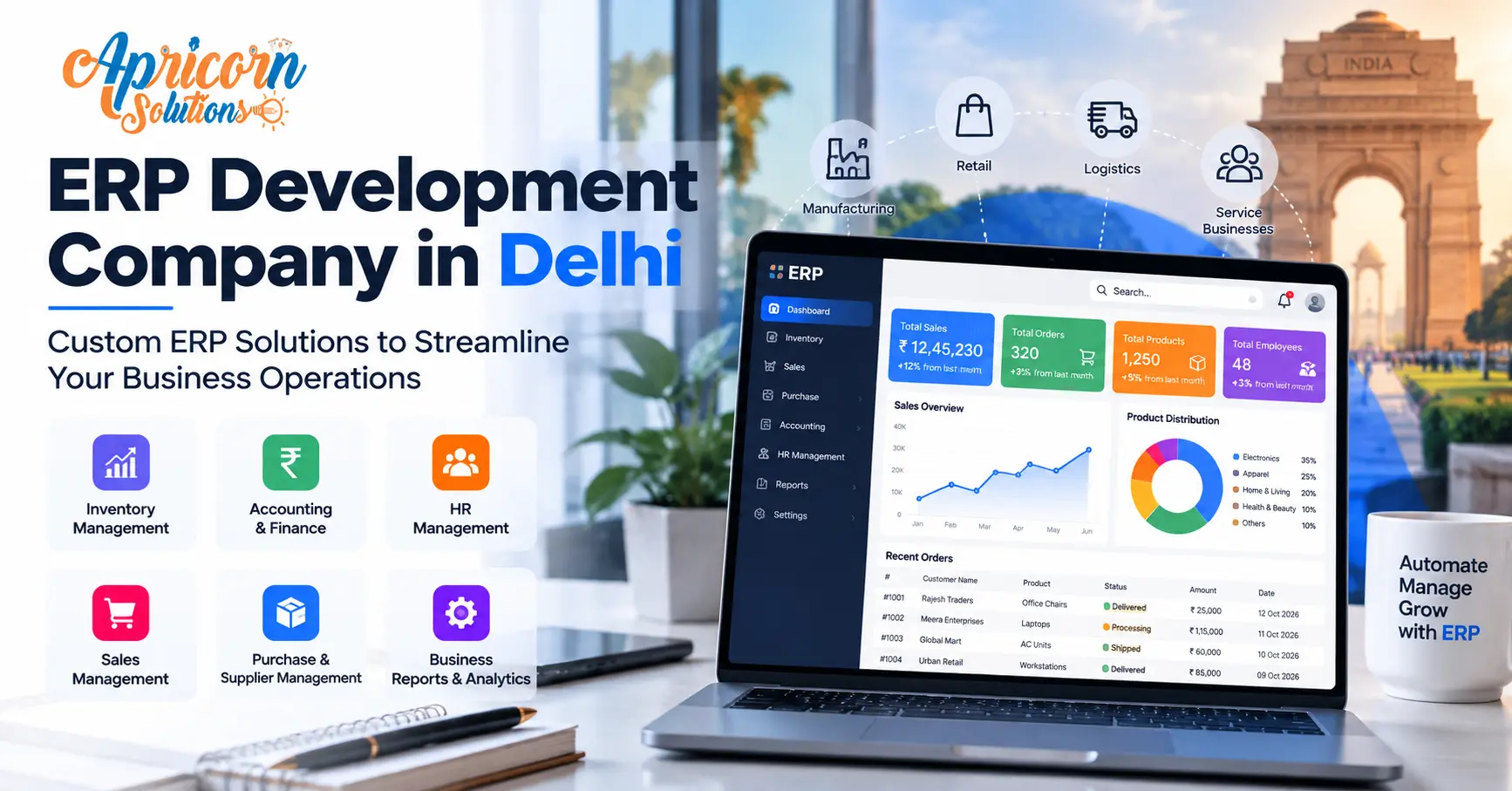
ERP Development Company in Delhi: Custom ERP Solutions for Businesses
Businesses in Delhi are increasingly adopting digital solutions to improve productivity, manage daily operations, and make better decisions. An Enterprise Resource Planning (ERP) system helps businesses bring essential processes such as inventory, finance, sales, purchasing, and employee management into one centralized platform. Choosing the right ERP development company in Delhi can help organizations reduce manual work, improve data visibility, and streamline business operations.
Apricorn Solutions provides software and ERP development services for businesses looking to improve operational efficiency through customized technology solutions. Whether you operate a manufacturing unit, trading business, distribution company, or service organization, selecting an ERP system that fits your workflow is essential for long-term growth.
What Is ERP Software?
Enterprise Resource Planning (ERP) software is a business management system that connects multiple departments through a shared platform. Instead of maintaining separate spreadsheets and disconnected applications, businesses can manage important information in one integrated system.
For example, when a sales order is confirmed, an ERP system can help update inventory records, generate billing information, and support delivery planning. This improves coordination between departments and reduces repetitive data entry.
A well-planned ERP solution can help businesses with:
-
Centralized business data and reporting
-
Inventory and stock management
-
Accounting and financial records
-
Sales and customer order management
-
Purchase and supplier coordination
-
Employee and attendance management
-
Workflow automation and business reporting
The exact features depend on the business requirements, industry, and ERP implementation plan.
Why Choose an ERP Development Company in Delhi?
Delhi and the wider NCR region have businesses across manufacturing, retail, wholesale, logistics, healthcare, and professional services. As operations grow, managing different departments through disconnected systems can become time-consuming and error-prone.
Working with an experienced software development company in Delhi can help businesses identify operational gaps and implement software around their actual processes.
1. Improve Operational Efficiency
Manual data entry and repetitive administrative tasks consume time. ERP automation can connect workflows and reduce duplication, allowing teams to focus on more valuable work.
2. Access Centralized Business Information
When departments maintain separate records, managers may struggle to obtain consistent information. ERP software centralizes key business data, making reporting and coordination easier.
3. Monitor Inventory and Orders
Inventory-focused ERP modules can help businesses track stock levels, purchases, sales orders, and product movement. This is particularly useful for manufacturers, wholesalers, retailers, and distributors.
4. Make Better Business Decisions
Dashboards and reports can help managers review sales performance, expenses, outstanding payments, stock movement, and other operational indicators.
5. Support Business Growth
A scalable ERP solution can be expanded as a business adds employees, locations, products, or operational processes. The system should be planned around both current needs and realistic future requirements.
Essential Features of Custom ERP Software
The right ERP system depends on how a business operates. Before selecting ERP development services, identify which modules are essential and which can be introduced later.
Inventory and Warehouse Management
Inventory management features help track stock availability, product movement, purchase receipts, and dispatches. Depending on requirements, the system may support multiple warehouses, stock alerts, and batch-level tracking.
Accounting and Financial Management
Financial modules can help manage invoices, expenses, payment records, and financial reports. Integration requirements should be defined clearly, especially when a business already uses accounting software.
Sales and Customer Order Management
Sales modules can organize quotations, customer orders, invoices, and order status. Connecting sales with inventory helps teams understand whether products are available before confirming delivery commitments.
Purchase and Supplier Management
Purchase management can help businesses record purchase requests, supplier details, orders, and received goods. Defined approval workflows can improve visibility and control over procurement.
Human Resource Management
Depending on the scope, an ERP system may include employee records, attendance, leave requests, and payroll-related workflows. Payroll and statutory requirements should be validated for the relevant business and jurisdiction.
Reporting and Analytics
Dashboards can summarize important operational information in a single view. Reports should focus on useful business metrics rather than collecting data that managers rarely use.
Custom ERP Software vs. Ready-Made ERP
Businesses generally evaluate ready-made ERP products and customized ERP software before making a decision.
Ready-made ERP systems may be suitable when standard features cover most requirements and the organization wants to adopt an established product. Custom ERP software development may be worth considering when the business has specialized workflows, unique approval processes, or integration needs that standard configurations cannot address efficiently.
Consider these factors before choosing:
-
Business requirements: Are standard modules sufficient for your processes?
-
Customization: Will you need specialized workflows or reports?
-
Integration: Must the system connect with existing applications?
-
Implementation: How much training and process change will be required?
-
Total cost: What will development or licensing, deployment, support, and maintenance cost over time?
-
Scalability: Can the solution support expected business growth?
A customized system is not automatically the best choice for every organization. The right approach balances functionality, implementation effort, maintainability, and overall cost.
Which Industries Can Benefit from ERP Solutions?
ERP systems can support different industries when their modules are designed around the relevant business processes.
Manufacturing
Manufacturers may use ERP software to coordinate raw materials, inventory, purchase orders, production planning, and finished goods. Advanced requirements can include bills of materials and production tracking.
Retail and Wholesale
Retailers and wholesalers can benefit from inventory visibility, sales records, supplier coordination, and order management. Businesses with multiple outlets may also require centralized stock reporting.
Logistics and Distribution
Distribution businesses may use ERP systems to coordinate orders, warehouse operations, dispatches, and billing. Integrations with logistics tools depend on the selected system and project scope.
Healthcare
Healthcare organizations may require systems for administrative workflows, billing, inventory, and internal reporting. Any solution involving patient information must also account for applicable privacy, security, and regulatory requirements.
Service-Based Businesses
Service organizations may need project tracking, resource allocation, invoicing, employee records, and management reports. ERP modules can be selected according to the organization's operating model.
How to Select the Right ERP Development Company in Delhi
Choosing an ERP development partner is an important decision because the software may influence several business departments.
Understand Your Business Requirements
Document the problems you want to solve before discussing features. Identify bottlenecks, manual tasks, reporting gaps, and the departments that need to share information.
Review Relevant Technical Experience
Ask potential developers about their experience with similar workflows, database design, integrations, security, deployment, and ongoing maintenance. Request relevant examples where available.
Confirm the Project Scope
The proposal should explain the modules, user roles, integrations, deliverables, testing process, implementation stages, and exclusions. A clear scope reduces misunderstandings during development.
Discuss Data Security and Access Control
Business information should be protected through suitable user permissions, secure authentication, backups, and data-handling practices. Requirements will vary depending on the information the system stores.
Evaluate Training and Post-Launch Support
Employees need to understand how to use the new system. Discuss documentation, training, bug fixes, upgrades, and support arrangements before signing off on the project.
Compare Total Cost, Not Just Initial Price
The overall cost may include discovery, development or licensing, data migration, integrations, training, hosting, support, and future enhancements. Ask for a transparent breakdown based on the agreed requirements.
ERP Implementation Process: Step by Step
A structured implementation plan helps reduce disruption and makes project progress easier to measure.
Step 1: Requirement Analysis
The development team and business stakeholders identify workflows, pain points, users, reports, and expected outcomes.
Step 2: Planning and Solution Design
The team defines modules, user permissions, system architecture, integrations, and the implementation roadmap.
Step 3: Development and Configuration
The selected ERP system is configured or developed according to the approved requirements.
Step 4: Data Migration and Integration
Existing business records are cleaned and transferred where required. Integrations with accounting, CRM, e-commerce, or other applications are tested according to the project scope.
Step 5: Testing and User Training
The system is tested for functionality, permissions, reporting, and relevant workflows. Employees receive training before the full rollout.
Step 6: Deployment and Ongoing Improvement
After deployment, the business monitors system performance, gathers user feedback, and addresses issues through the agreed support process.
A phased rollout may be appropriate when a business wants to introduce modules gradually or minimize disruption to daily operations.
What Determines ERP Development Cost in Delhi?
There is no single price that applies to every ERP project. The cost depends on the scope, complexity, and technology requirements.
Key cost factors include:
-
Number of modules and business processes
-
Number of users, locations, and warehouses
-
Custom workflows and reporting requirements
-
Integration with existing software
-
Data migration and cleanup
-
Hosting, infrastructure, and security requirements
-
Training, maintenance, and ongoing support
A basic system with a limited number of modules will usually require a different investment from a multi-location ERP platform with complex integrations. Request a requirement-based proposal rather than relying on a generic price estimate.
ERP Development Services by Apricorn Solutions
Apricorn Solutions provides software development and ERP-related services for businesses seeking technology solutions aligned with their operational requirements. The company is based in Sonipat, Haryana, and serves clients beyond its home location.
Businesses in Delhi can discuss their workflows, reporting needs, integration requirements, and automation goals with the team to understand whether a customized ERP solution is suitable for them.
Explore ERP development services by Apricorn Solutions to learn more about its ERP offering. You can also review its custom software development services if your project requires broader application development or integration work.
The best ERP approach begins with understanding the business problem. A clear scope, practical implementation plan, employee training, and appropriate ongoing support are all important for achieving value from the system.
Conclusion
Choosing the right ERP development company in Delhi starts with identifying your business challenges and selecting a solution that addresses them without unnecessary complexity. From inventory and accounting to sales, purchasing, and reporting, a well-planned ERP system can improve coordination and provide better visibility into daily operations.
Before investing, compare implementation approaches, confirm integration and security requirements, and evaluate the total cost of ownership. If your business is exploring ERP or custom software solutions, visit Apricorn Solutions to discuss your requirements and identify a suitable next step.