


- By Yash Kuchhal — Founder & CEO, Apricorn Solutions
- seo
- Published:
- Last Updated:
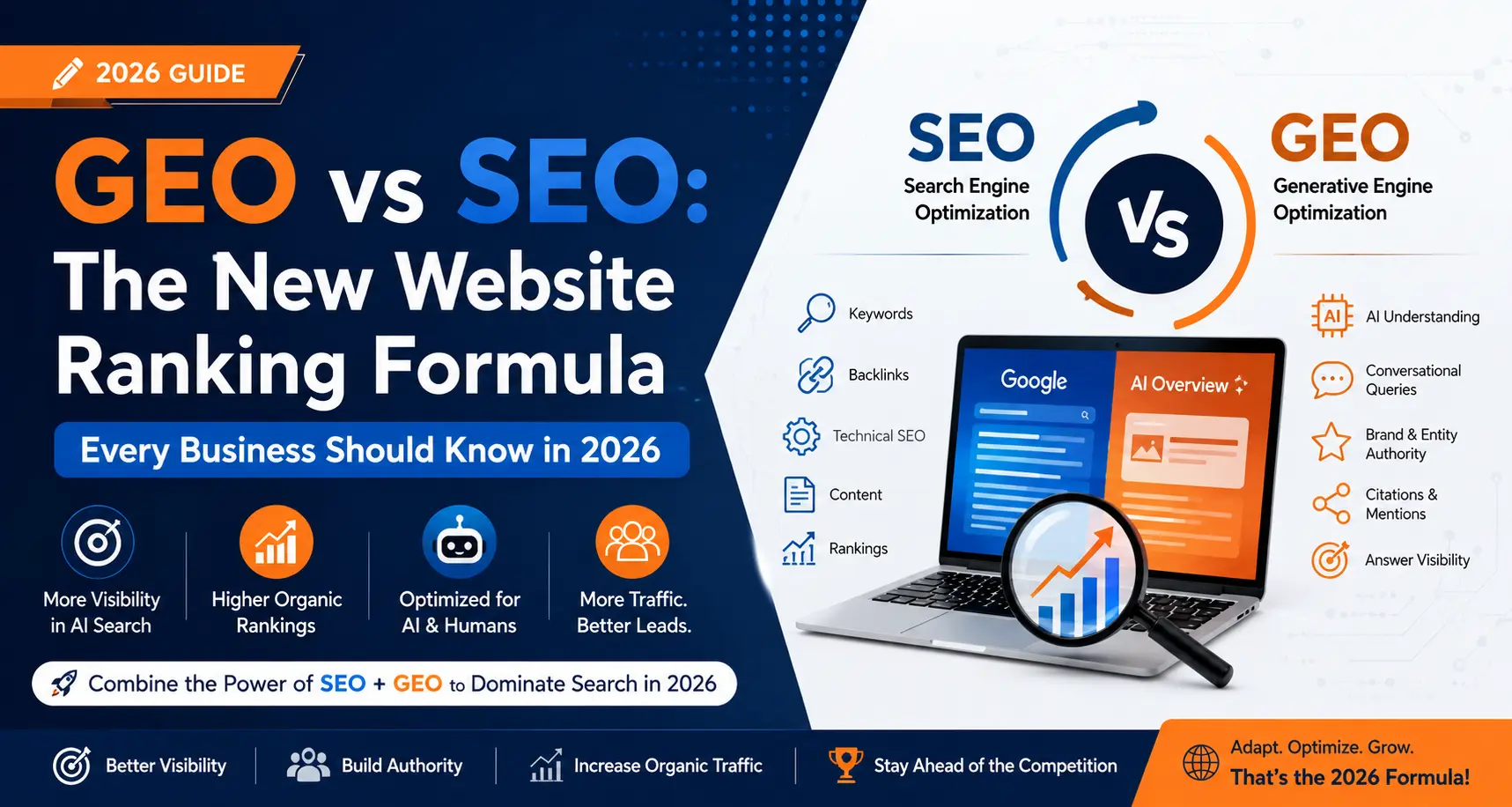
GEO vs SEO: The New Website Ranking Formula Every Business Should Know in 2026
Consider two businesses that are the same in every way, including their positions in the search results. One is getting calls and requests and is getting great leads. The other business is getting poor responses and requests.
I have seen this exact scenario many times with actual businesses, and my clients have described this scenario many times. I have been asked many times, "Why are customers not calling us if we are in 3rd position on Google?" This is a fair question, especially if the business has invested a lot in search engine optimization. It doesn't matter whether they are employing an SEO company in Andhra Pradesh, Rewari, Jhajjar, Palwal, or Gurgaon. High ranking in search engines is not enough for business growth.
The answer is that search ranking and visibility in search engines are two different things. There have been many changes and improvements in search engine technology, and Google has added artificial intelligence to provide answers and information directly in search results. As a consequence, users find the answer to their question without visiting a website, which has decreased traditional website traffic and increased searches without clicks.
There is no doubt that as ChatGPT, Google Gemini, Perplexity AI, Claude, and other generative search engines develop, so too do the search functionalities of consumers and businesses. With the launch of the now obsolete "Ten Blue Links" model, Google left search engine users no other choice than to scroll through hundreds, if not thousands, of search results. With the latest generative search engines, users can phrase search queries as complete questions. Instead of merely providing answers, search engines respond with AI-generated answers that include not only a summary of the answers but also citations to highly rated and recommended sources. With the rise of generative search engines, the paradigm of search engine optimization has shifted. Being mentioned, cited, or recommended by an AI is now as important as achieving a first-page rank in Google search results.
The recent model of GEO vs. SEO (or ranking model) for the year 2026 emphasizes the importance of generative search engines. Traditionally, SEO (search engine optimization) was the most effective means to funnel content to a specific audience through web traffic. These are still important; however, modern rules focused on generative search engines, or GEO (generative engine optimization), have also changed the landscape. Website content needs to be trustworthy, clear to AI, and recommended for citation.
What is Traditional SEO?
The traditional understanding of SEO was simple. Help Google understand your page, and it will show it to the people it thinks are relevant.
Traditionally, this involved applying a well-known combination of skills to the following:
- Keywords: Using the precise words and phrases people entered into search engines.
- Backlinks: Getting website links from other, reputable websites.
- Technical SEO: Maintaining site performance (speed, mobile optimization, clean and proper code, and indexing).
- Content: Making content that is responsive to specific search queries.
- User Experience: Improving how easy or difficult it is to navigate a website.
There was great success with this methodology because Google had the straightforward task of organizing search queries and displaying the top 10 results as a list of links,, and optimizing as much as required in the five areas described above guaranteed a great chance of landing among the top 10 search results.
The search engine optimization (SEO) practice had an immediate benefit. It had the predictability of being able to determine search rankings and track and measure site visits.
Historically, and most recently, the biggest limitation of search engine optimization (SEO) practices was that they were designed for a time when people were the ones reading and scanning every search result. Now, there are so many AI systems that, with just one clean response to a query, can read, analyze, and summarize the top ten websites without generating traffic to any of them.
What is Generative Engine Optimization (GEO)?
GEO refers to the practice of making content that will be referenced or cited as a source of information when AI systems (Google, ChatGPT, Gemini, Claude, Perplexity, etc.) generate their own responses.
The classic approach to SEO is different from this. Advanced search and AI systems do not evaluate and rank search results like the traditional Google algorithms do. Rather, they read and understand the content and the relationships between the pieces of content, and assess the trustworthiness of the content to be quoted, summarized, and/or recommended.
This is based on a few central ideas.
Conversational Search
Users do not usually search for queries like "the best plumber in Vijayawada" on ChatGPT. Instead, you should expect the search to be more about "who is a plumber that can come to my house today and is reliable?"
Content developed to answer questions conversationally is more effective than content developed to answer questions in a keyword-optimized manner.
Entity Authority
Advanced systems are more interested in the content around businesses. A business referenced and/or reviewed across multiple content sources is more credible in the eyes of advanced systems than one that exists solely on its own website.
Topical Authority
Real expertise is better demonstrated through multiple interconnected content pieces than by a single ranking content piece focused on a single topic.
Structured Data
Compared to traditional content, advanced systems find it easier to extract and trust the information you present on your website if you incorporate schema markup.
GEO vs SEO Comparison Table
FactorSEOGEO
Ranking Method Keyword relevance, backlinks, and other technical signals Understanding content, trust in the entity, and the credibility of the source
Traffic Source Organic clicks from search results AI citations, zero-click visibility, and brand recall
Content Style Keyword-optimized pages Question-and-answer style, in-depth, and entity-rich content
Authority Domain authority and backlinks Topical depth, mentions, and expert reputation
User Intent Matched through keyword phrasing Understood through natural language context
AI Visibility : Limited and mostly indirect ; Direct and content can be quoted or summarized.
Future Scope Still relevant but diminishing in influence Growing rapidly with the increase of AI.
Best Use Cases Product pages, local listings, and transactional searches Informational content, expert guidance, and comparison content
Why SEO Alone Is No Longer Enough
After Google expanded the roll-out of AI Overview, a new trend has emerged: businesses can rank and still see virtually no traffic. This is due to an increasing number of searches completing on the results page, a phenomenon known in the industry as "zero-click searches."
A few things are causing this change:
- Most of the time, AI Overviews tend to answer your question before you have the chance to finish scrolling.
- Voice search prefers direct, short answers rather than lists of links to various sites.
- Conversational search prefers answers written as if they were responding, rather than as a sales pitch.
- AI-featured answers and citations are the new way of determining who gets a reference in the answer.
- Entity recognition tells us that most AI tools care more about who you are on the web (the real you) than what you have said on a single page.
This has not made SEO irrelevant. This has shown that SEO alone answers half of the existing questions.
The New Website Ranking Formula in 2026
The working and successful formula for businesses adapting well is:
Website Ranking = Technical SEO + Helpful Content + Entity Authority + EEAT + Brand Mentions + AI Citations + User Experience + Structured Data + Fresh Updates
What this all means when put into practice is the following:
Technical SEO
Your site must be efficiently designed to load quickly and display correctly across all formats. This is a requirement, not the primary focus.
Helpful Content
Content that offers genuine responses when written rather than for a specific word or keyword target.
Entity Authority
Your business is recognized as a real, reliable entity online through mentions, directories, and reviews.
EEAT
Show real experience, expertise, and authority through personnel bios, credentials, and honest replies.
Brand Mentions
Being discussed on other sites, even without hyperlinks, increases credibility in the eyes of AI.
AI Citations
Allow AI tools to extract information from your site with quotes and citations.
User Experience
Create a site that is easy to use once someone clicks through.
Structured Data
Use schema markup that makes your content readable to machines.
Fresh Updates
Keep content up to date to show it remains relevant.
Conclusion
The "geo vs seo website ranking formula 2026 " conversation isn't really about choosing sides. It's about understanding that ranking well on Google and being visible to AI search tools now require overlapping but distinct efforts. Technical SEO still matters. Helpful, expert-driven content matters more than ever. Businesses that treat these as a single, connected strategy — rather than picking one over the other — are set up to stay visible as search continues to evolve.