

- By Yash Kuchhal — Founder & CEO, Apricorn Solutions
- Digital marketing
- Published:
- Last Updated:
SEO vs Google Ads: Which Is Better for Your Business?
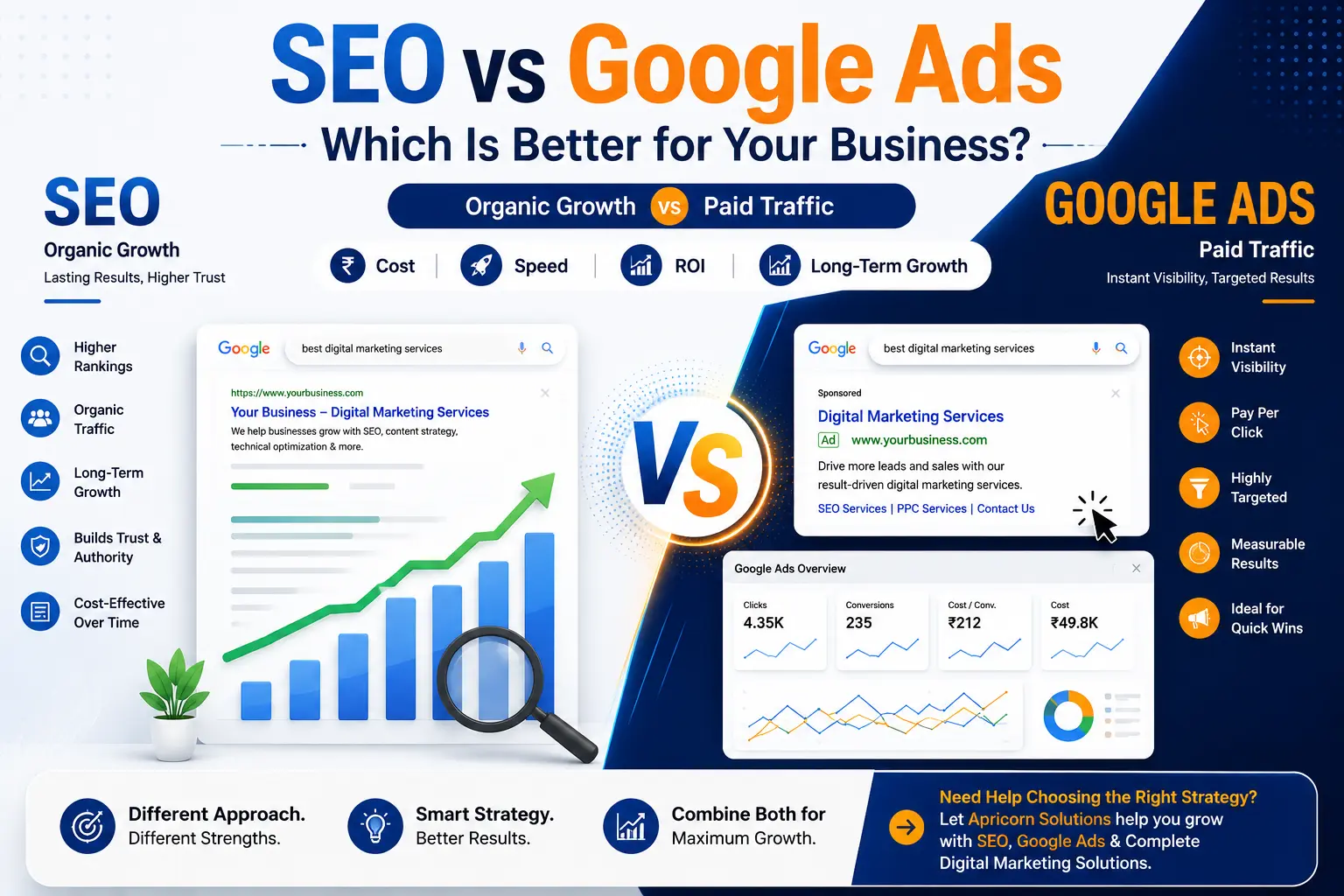
Choosing between SEO and Google Ads can be challenging when your main goal is to generate more customers from Google. SEO can build organic visibility over time, while Google Ads can help you reach relevant searchers through paid advertising.
SEO can help your website improve its organic ranking over time, and Google Ads can put your company's name in front of relevant searchers via paid ads. Both can lead to leads and traffic; however, they operate in different ways.
Which one is the best for your company to invest in?
The answer will depend on your objectives and budget, your customers' journey, competition, and the speed at which you want results. If you require immediate and targeted exposure, Google Ads may be the ideal place to begin. If you are looking to create an organic and sustainable authority as well as traffic, SEO may be the most long-term option.
In many companies, the best strategy isn't to choose one method over the other. It's knowing the best time and method to utilize each.
SEO vs Google Ads: Quick Answer
SEO is generally more effective for long-term organic visibility; however, Google Ads is better when you require targeted traffic to be delivered quickly.
SEO is a method of making your website more likely to be found in organic results in search. Google Ads uses paid advertising to display relevant ads to users who are looking for products or services. Google claims that SEO assists search engines in understanding the content of websites and assists users in finding websites by searching, and Google Ads allows advertisers to connect with potential customers and manage their budgets for advertising.
If your company requires immediate growth, Google Ads can be helpful. If you're looking to establish an online presence that will continue to draw people throughout the years, SEO deserves a place in your marketing plan.
What Is SEO?
Search Engine Optimization (SEO) is the process of improving a website’s content, technical performance, and user experience so search engines can better understand its pages and users can discover them through relevant organic search results.
SEO goes beyond the addition of keywords to websites. A solid strategy may include:
- Keyword research and research on search intent
- Original and helpful content
- Optimization of the page
- Technical SEO
- Website speed and mobile accessibility
- Internal link
- Local SEO
- Structured data
- Digital authority and links to relevant sites
- Website improvements focusing on conversion
Google's SEO guidelines emphasize the importance of content that is distinctive, well-written, and written specifically for users rather than search engines.
The most important thing to remember is that SEO generally requires time. Rankings are based on factors like competition, site quality, relevancy to the market, authority, and content, as well as the current quality of the website.
What Are Google Ads?
Google Ads is Google's online advertising platform. Businesses can set up campaigns that display ads to users who are searching for relevant products and services.
In Google Search Ads, keywords help businesses reach users who are actively searching for relevant products or services. Google determines which ads appear through an auction system that considers factors such as bids, ad relevance, and landing-page experience. As search behavior evolves beyond traditional search, understanding SEO vs GEO can also help businesses plan a broader strategy for organic visibility across search engines and AI-powered search platforms.
Through cost-per-click bidding, marketers pay for each time a user clicks on the ad, though the actual cost could be less than the maximum CPC bid. Businesses also have control over budgets for campaigns in addition to bidding strategy.
This means that Google Ads is especially efficient when you wish to gauge demand, advertise an offer, or create targeted traffic, without having to wait until organic ranking to build.
SEO vs Google Ads: Key Differences
Business Situation Best Starting Point Why It Makes Sense
Need leads quickly Google Ads Helps you reach people actively searching for your products or services.
Want long-term organic growth SEO Builds organic visibility and can generate search traffic over time.
New website with little search visibility SEO + Targeted Google Ads SEO builds the foundation while Ads can help generate initial visibility and traffic.
Running a seasonal offer Google Ads Helps promote time-sensitive offers to relevant searchers quickly.
Local service business Local SEO + Google Ads Combines organic local visibility with targeted paid search traffic.
E-commerce business SEO + Google Ads SEO supports long-term product visibility, while Ads can capture high-intent buyers.
Testing a new service or market Google Ads Provides faster feedback on search demand and customer interest.
Customers take time to make a decision SEO + Selective Google Ads SEO supports the research journey while Ads can capture high-intent searches.
Working with a limited marketing budget Focus on High-Intent Opportunities Concentrate your budget on searches most likely to generate qualified leads or sales.
Already have strong organic visibility SEO + Selective Google Ads Paid campaigns can help capture additional commercial opportunities beyond organic traffic.
Both channels aren't necessarily better. The best choice is contingent on the needs of your company from Google in the moment.
SEO vs Google Ads: Which Is Faster?
Google Ads generally has an advantage if speed is the main consideration.
When a campaign is designed, approved, and able to run, paid ads begin to generate clicks and impressions. However, the word "visibility" does not automatically translate into sales. Keyword selection, targeting of campaigns, as well as ad relevancy and landing-page quality all affect the performance.
SEO is different. Websites may require time to enhance their foundational technical structure, quality of content, as well as its relevance and authority before more organic search engine visibility is established.
It doesn't make SEO slow or unproductive. This means SEO, along with Google Ads, operates on different time slots.
Do you need to be seen now? Consider Google Ads.
Building long-term search visibility? Invest in SEO.
Avoid any business that claims to guarantee Google results or guaranteed sales within a set period of time. The performance of Google's search engine is contingent on the marketplace, the website, and competition, among other factors.
Which Is More Cost-Effective: SEO or Google Ads?
There isn't a universal solution since the actual cost is contingent on the economics of your company.
SEO investment may include:
- Strategies and research
- Creation of content
- Optimization of the technical aspects
- Local SEO
- Improvements to the website
- Building for authority
- Monitoring continues
Google Ads expenses can comprise:
- Advertising spending
- Campaign management
- Keyword research
- Landing-page development
- Conversion tracking
- Ad-testing
- Continuous improvement
When you use Google Ads, your business will be charged according to the billing and bidding model. When you use CPC campaigns, you are charged for each click.
SEO shouldn't be characterized in the sense of "free web traffic." Proficient SEO takes time, experience, along with content and continuous optimization.
The more important answer is:
Which of the channels can provide competent customers at an acceptable purchase cost?
Which Gives Better ROI: SEO or Google Ads?
The sole measure of traffic is not a good method to gauge the success of marketing.
Imagine two different campaigns.
One attracts 10,000 people; however, it only generates a few inquiries.
Another one brings 500 highly relevant customers and leads to 30 qualified leads.
The second one could be more effective even if its traffic is less.
The ROI analysis you conduct should be based on:
- Leads that are qualified
- Sales
- Cost per lead
- Costs for customer acquisition
- Conversion rate
- Average order value
- Customer lifetime value
- Profit and revenue
When it comes to Google Ads, conversion tracking is crucial because the company must know what happens after a click.
To measure SEO, not just rankings and traffic, but also the pages that result in calls, enquiries, and purchases as well as other significant business activities.
When Should Your Business Choose SEO?
SEO might be the best starting point for your company if:
- Needs organic traffic that is sustainable
- You are able to invest in a consistent manner over the course of time.
- Has valuable search demand
- Needs to establish online authority
- Depends on the local area
- The company wants to decrease dependence on ad-hoc traffic
- Offers a variety of commercial and informational topics that are appropriate for the target audience.
- Does not want to be seen throughout the customer journey
SEO is particularly effective for B2B firms, SaaS brands, e-commerce stores, educational firms, and local companies.
It is particularly helpful for customers to research issues prior to contacting an organization.
When Should Your Business Choose Google Ads?
Google Ads may be more logical in the following situations:
- You'll need to get traffic speedily
- You're launching a brand new service
- You've got a deal that's time-sensitive
- You're looking to test market demand
- Your keywords demonstrate an incredibly commercial intention
- You have a landing page
- It is possible to measure sales or leads with precision.
Google Ads can also help businesses determine which search phrases, offers, and landing pages draw the attention of businesses.
But just raising the advertising budget will not guarantee better results. Google examines various factors, including the bid, the quality of ads, as well as the relevancy of the landing page experience, in determining the ad's eligibility and the position of the ad.
SEO vs Google Ads for Small Businesses
Small-scale businesses typically assume that they need to decide between investing heavily in SEO or investing heavily in advertising.
The best approach is to determine the highest-value opportunity first.
For instance, a local service company could include:
- Google Business Profile optimization
- Local SEO
- Optimizing the service page
- A very small, but precisely focused Google Ads campaign
- Conversion-focused landing pages
- Lead tracking that is accurate
Instead of focusing on thousands of broad keywords, a business could focus on search terms that are closely related to its products and geographical location.
The aim is not to have the highest traffic.
The aim is to maximize profitable business opportunities based on the budget available.
SEO vs Google Ads for E-Commerce Businesses
E-commerce companies can gain from both of these channels.
SEO could help support:
- Pages for categories
- Product pages
- Guides for buying
- Informational content
- Comparisons of products
- Organic discovery of products
Google Ads may be used to support:
- Shopping campaigns
- Search-related campaigns
- Campaigns for promotion
- High-intent product searches
- Remarketing
- New-product launches
A well-balanced strategy will allow paid advertising to take advantage of immediate interest, while SEO creates organic exposure for the products and subjects that customers frequently search for.
Can SEO and Google Ads Work Together?
Yes. In many instances, it is possible to create more effective strategies for search marketing.
Google Ads can help with instant visibility as well as market research. SEO can increase organic authority and visibility over a long time.
For instance, if Google Ads shows that a certain service keyword generates consistently qualified inquiries, this information can be used to inform future SEO pages and content.
But there's a crucial difference:
The use of Google Ads doesn't directly increase your organic Google positions.
Paid advertisements and organic search are distinct platforms. Google Ads is an advertising platform, whereas SEO is focused on organic search visibility.
SEO vs Google Ads: Decision Matrix
Utilize this framework to help you in making a decision about where to place your budget for marketing.
Your Business Situation Recommended Starting Point Why
Need leads quickly Google Ads Helps you reach high-intent searchers faster
Want long-term organic growth SEO Builds sustainable organic visibility over time
Have a new website with little or no search visibility SEO Foundation + Targeted Google Ads Builds long-term visibility while generating initial traffic
Running a seasonal promotion Google Ads Useful for time-sensitive offers and campaigns
Local service-based business Local SEO + Targeted Google Ads Combines organic local visibility with paid search exposure
E-commerce store SEO + Google Ads Supports long-term product visibility and immediate paid traffic
Testing a new market or service Google Ads Helps validate search demand before making a larger SEO investment
Customers have a long research journey SEO + Selective Google Ads SEO supports research while Ads can capture high-intent searches
Have a limited marketing budget Start with the Highest-Intent Opportunity Focuses limited resources where they are most likely to generate qualified leads
Already have strong organic visibility SEO + Selective Google Ads Paid campaigns can capture additional commercial opportunities
It isn't a strict formula. Your business competitiveness, margins, and the cost of acquisition for customers should be the determining factors for your final strategy.
Illustrative Case Study: A Local Service Business
Note: It is an illustrative scenario, not a confirmed Apricorn Solutions Case Study.
Think about a local service company with a newly redesigned website. It offers excellent services, but has very poor organic visibility, and is looking for more qualified inquiries.
Instead of putting all budgets in one channel, a business could consider a two-stage strategy.
Stage 1: Google Ads
The company creates highly targeted ads around specific service-related searches.
It tracks:
- Clicks
- Enquiries
- Leads with a valid qualification
- Conversion rate
- Cost per lead
This gives fairly quick feedback on which services and search terms can attract prospective customers.
Stage 2: SEO
While at the same time the business grows:
- Service pages
- Local SEO
- Technical performance
- Search-intent-focused content
- Internal link
- Conversion elements
As time passes, the objective is to improve organic exposure so that the company does not rely entirely on clicks from paid ads.
The takeaway is easy: use paid search for speed and then build SEO when visibility is important for the long run.
Why Your Website Matters for Both SEO and Google Ads
A successful marketing campaign will not fully compensate for a weak website.
If a site's page is difficult, slow, confusing, or difficult to navigate, or lacks the obvious next step, it could result in wasted opportunities.
Your site should include:
- Mobile-friendly and fast-loading pages
- Service information that is clear
- For advocacy and action
- Simple inquiry forms
- Signals of trust
- Relevant landing pages
- Simple navigation
- Convert accurately and track conversions
For instance, a business that is working with a web development company located in Kerala must consider SEO structure and requirements for conversion when developing the website rather than trying to resolve every issue when launching ads.
In the same way, companies that develop SaaS platforms or custom-designed technology products could collaborate with a software development firm located in Bangalore when planning the website, application, and lead generation journey.
To help businesses improve the structure of their websites and landing pages, a website development firm located in Pune could be part of the overall digital expansion process.
The principle behind this is the same: SEO and advertising will bring visitors to your site. Your website must provide them with an incentive to act.
Why SEO and Google Ads Need Ongoing Strategy
It is not recommended that SEO or Google Ads should be treated as a one-time configuration.
SEO requires continuous attention:
- Search intent
- Content quality
- Technical problems
- Internal link
- Organic performance
- Search demand
- Changes to the website
Google Ads requires:
- Keyword research
- Negative management of keywords
- Ad-testing
- Optimizing landing pages
- Conversion tracking
- Budget and bid management
- Analysis of search terms
Google's advertising manual also stresses the importance of relevancy and landing page quality in the auction.
This means that the most effective results are usually derived from constant testing and improving rather than merely starting a campaign and then just waiting.
Expert Perspective: Which Should You Choose?
From a practical business perspective, the decision should begin with the customer journey rather than the marketing channel itself, instead of the channel for marketing.
If a buyer is on Google this morning and is looking to purchase, Google Ads can help you meet that need.
If your customers conduct lookups, compare research, and study before making a final decision, SEO can help your company be seen at different levels of that process.
For many businesses that are growing, the best plan of action is:
Google Ads for immediate opportunities + SEO for long-term visibility.
The best balance is dependent on budget and competition, the conversion rate, customer lifetime value, and business goals.
Final Verdict: SEO vs Google Ads - Which Is Better?
There isn't a universal winner in the battle between SEO and Google Ads.
For businesses with sufficient resources, combining both can be effective: Google Ads can capture immediate opportunities, while SEO can build sustainable organic visibility over time.
Before making a decision, take a look at your budget, competitors, customers, customer journey and conversion rate, cost for customer acquisition, and the timeframe.
The most important thing to remember is that you shouldn't pick an advertising channel based on the fact that it's well-known. Select a channel that is compatible with the way that your customers browse and purchase.
If you need assistance deciding whether SEO, Google Ads, or the combination of both is right for your company, Apricorn Solutions will help you evaluate your website's search potential as well as the conversion process and marketing needs prior to investing.
Sources & Further Reading
- Google Search Central -- SEO Starter Guide
- Google Search Central -- Creating Helpful, Reliable, People-First Content
- Google Ads Help -- How the Google Ads Auction Works
- Google Ads Help -- Cost Per Click (CPC)