

- By Yash Kuchhal — Founder & CEO, Apricorn Solutions
- APP Development
- Published:
- Last Updated:
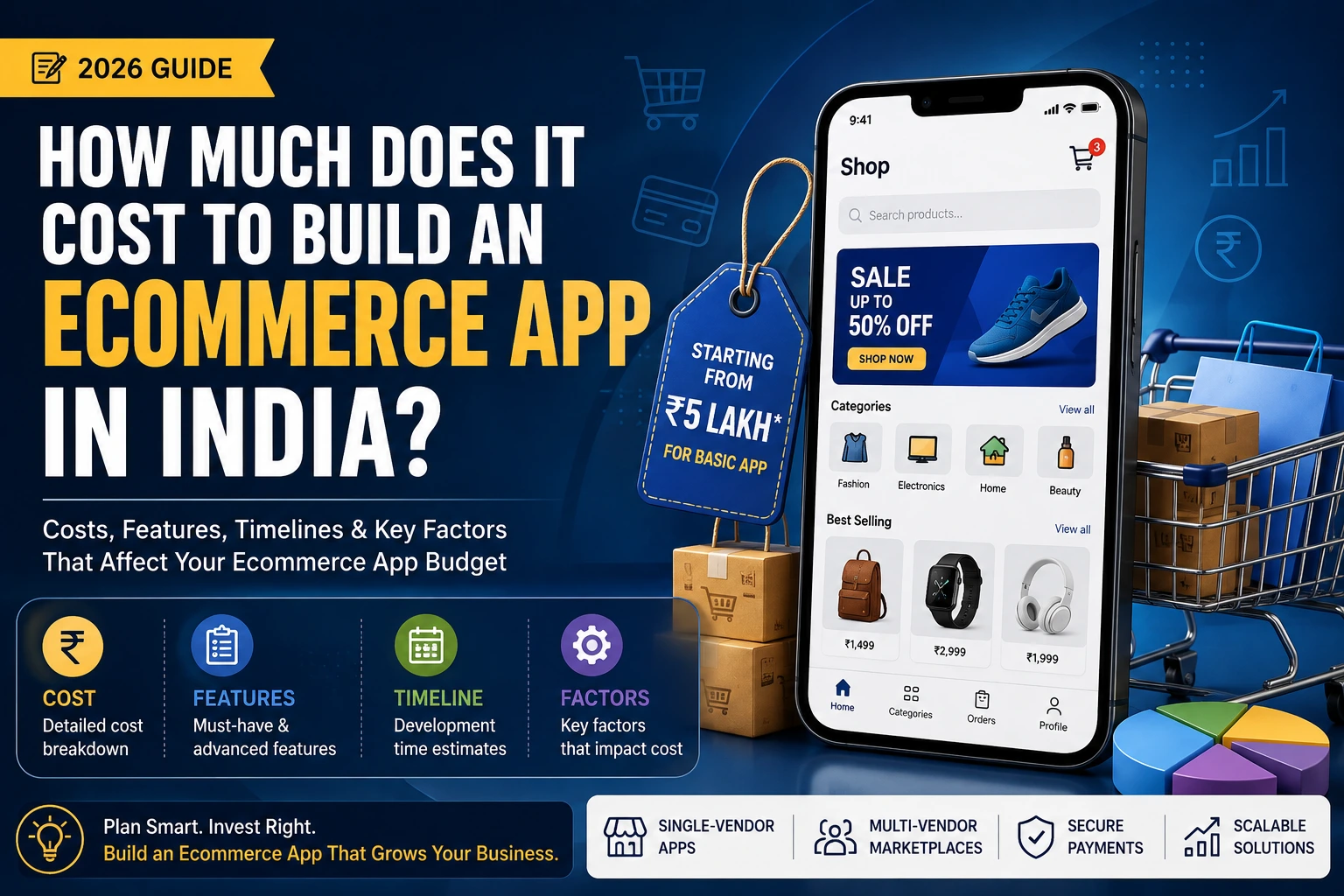
How Much Does It Cost to Build an Ecommerce App in India?
Building an ecommerce app is about much more than displaying products on a mobile screen. A successful ecommerce application needs to make shopping simple, payments secure, orders easy to manage, and customer interactions smooth. Behind the app, businesses also need reliable backend infrastructure, inventory management, analytics, integrations, and ongoing technical support.
If you want to understand the broader factors that affect app pricing, you can also explore our guide on mobile app development cost in India 2026. Before starting development, it is equally important to understand how to choose a mobile app development company in India.
Quick Answer: What Is the Cost of an Ecommerce App in India?
The estimated cost depends on the complexity and scope of the application.
Ecommerce App Type Approx. Development Cost Typical Timeline
Basic Ecommerce MVP ₹3–7 lakh 8–12 weeks
Standard Ecommerce App ₹6–15 lakh 12–20 weeks
Multi-Vendor Marketplace ₹15–30 lakh+ 5–9 months
Advanced / Enterprise Ecommerce Platform ₹30–70 lakh+ 6–12+ months
These figures are planning estimates rather than fixed quotations. The final cost depends on the number of features, platforms, UI/UX requirements, backend architecture, third-party integrations, testing, security, deployment, and post-launch support.
What Determines Ecommerce App Development Cost?
The biggest mistake businesses make is asking for a development price before defining what they actually want to build.
Several factors influence ecommerce app development cost in India.
1. App Complexity
The complexity of your ecommerce app is one of the biggest factors affecting development cost.
A basic ecommerce app with product listings, search, cart, checkout, and payment functionality requires significantly less development effort than a marketplace with multiple sellers, commissions, logistics management, and separate dashboards.
Basic Ecommerce App Features
A basic ecommerce application may include:
-
User registration and login
-
Product catalogue
-
Product search
-
Product details
-
Shopping cart
-
Checkout
-
Payment gateway
-
Order history
-
Basic admin panel
Advanced Ecommerce App Features
A more advanced application may include:
-
Multi-vendor management
-
Seller dashboard
-
Delivery tracking
-
Advanced search and filters
-
Product recommendations
-
Coupons and rewards
-
Multiple payment methods
-
Real-time notifications
-
Analytics dashboards
-
AI-powered personalization
-
ERP and CRM integration
Every additional workflow requires development, testing, design, integration, and maintenance effort.
2. Android, iOS, or Both?
The platforms you choose can also affect the overall development budget.
Building an application only for Android may require a smaller development scope than creating applications for both Android and iOS. If your project also includes a website, admin panel, backend, and seller dashboard, the total development effort increases further.
Cross-Platform vs Native Development
Frameworks such as Flutter allow businesses to develop Android and iOS applications using a shared codebase. This can reduce duplicated development work and may make cross-platform development a practical option for many ecommerce businesses.
Native development can be more suitable when an application requires highly platform-specific functionality, deep device integration, or specialized performance optimization.
The right choice should therefore be based on your features, performance requirements, integrations, scalability, maintenance needs, and long-term roadmap, rather than simply choosing the technology with the lowest initial cost.
3. UI/UX Design
Good ecommerce design is not simply about making an app look attractive. The interface should help customers move smoothly through the buying journey:
Discover → Compare → Add to Cart → Pay → Track Order
Important ecommerce UX elements include:
-
Simple navigation
-
Clear product categories
-
Fast search
-
Product filters
-
High-quality product images
-
Easy-to-understand product information
-
Clear pricing
-
Delivery information
-
Trust signals
-
Simple checkout
-
Easy payment flow
A template-based design can reduce the initial design investment. A completely custom design system with animations, personalized interfaces, prototypes, and extensive user testing can increase the overall cost.
4. Ecommerce App Features
Features are another major cost driver.
Essential Features
-
Sign up and login
-
OTP authentication
-
Product catalogue
-
Search
-
Filters
-
Product details
-
Wishlist
-
Shopping cart
-
Checkout
-
Payment gateway
-
Order tracking
-
Push notifications
-
Customer support
-
Admin dashboard
Advanced Features
-
Multi-vendor marketplace
-
Seller onboarding
-
Commission management
-
Delivery partner integration
-
Real-time order tracking
-
Subscription products
-
Loyalty programme
-
Referral system
-
AI product recommendations
-
Voice search
-
Advanced analytics
-
Personalized offers
Instead of launching every possible feature in the first version, businesses should prioritize features according to customer value, business goals, and revenue potential.
5. Payment Gateway Integration
Payments are at the heart of ecommerce.
An ecommerce app targeting Indian customers may need to support:
-
UPI
-
Credit and debit cards
-
Net banking
-
Wallets
-
Cash on Delivery
-
Other supported payment options
The cost and complexity of payment integration depend on the payment provider, checkout workflow, refund handling, transaction-status management, security requirements, and backend integration.
Payment functionality should also be thoroughly tested because failed transactions or incorrect order statuses can directly affect customer trust.
6. Backend and Admin Panel
Customers see the mobile application, but ecommerce businesses depend heavily on the backend.
An admin panel may be used to manage:
-
Products
-
Categories
-
Inventory
-
Orders
-
Customers
-
Discounts
-
Coupons
-
Payments
-
Shipping
-
Returns
-
Reviews
-
Notifications
-
Reports
For a multi-vendor marketplace, the backend becomes more complex because it may also need seller approvals, commissions, payouts, seller inventory, marketplace rules, and order allocation.
This is why an ecommerce app should not be priced only according to the number of mobile screens.
7. Third-Party Integrations
Third-party integrations can have a significant impact on development cost.
Common ecommerce integrations include:
-
Payment gateways
-
SMS and OTP services
-
Email services
-
Push notifications
-
Shipping APIs
-
Maps
-
CRM
-
ERP
-
Accounting software
-
Analytics platforms
-
Customer support tools
-
Social login
Each integration requires development, testing, error handling, and compatibility monitoring.
If integrations are added late in development, they can also cause scope changes and unexpected expenses.
Ecommerce App Development Cost Breakdown
A useful way to plan an ecommerce project is to divide the budget into major development areas.
Development Area Typical Cost Impact
Business & technical planning Low–Medium
UI/UX design Medium
Mobile app development High
Backend/API development High
Admin panel Medium–High
Payment integration Medium
Shipping & logistics integration Medium–High
Testing & QA Medium
Deployment Low
Post-launch maintenance Ongoing
These are relative cost drivers rather than fixed prices because every ecommerce project has different requirements, technologies, integrations, and scope.
Single-Vendor vs Multi-Vendor Ecommerce App Cost
This distinction can make a significant difference to your budget.
Single-Vendor Ecommerce App
A single-vendor ecommerce app sells products from one business.
The system may include:
-
Customer app
-
Admin panel
-
Product management
-
Inventory
-
Orders
-
Payments
-
Delivery management
A standard production-ready single-vendor ecommerce app may fall within the ₹6 lakh–₹15 lakh range, depending on its features and integrations.
Multi-Vendor Ecommerce Marketplace
A multi-vendor marketplace adds another layer:
Seller → Marketplace → Customer
It may require:
-
Seller registration
-
Seller dashboard
-
Product approval
-
Seller commissions
-
Seller payouts
-
Inventory management
-
Order allocation
-
Returns
-
Sales analytics
-
Customer management
Because of these additional workflows, multi-vendor development can move into the ₹15 lakh–₹30 lakh+ range. Advanced logistics, personalization, analytics, and enterprise integrations can increase the investment further.
How to Reduce Ecommerce App Development Cost
Reducing development cost does not mean selecting the cheapest development company. It means managing the project scope intelligently.
1. Start With an MVP
Launch with the features customers need most instead of building every advanced feature in the first version.
2. Prioritize Revenue-Generating Features
Invest first in features that can improve conversions, customer retention, or operational efficiency.
3. Consider Cross-Platform Development
For many businesses, Flutter or another cross-platform solution can reduce duplicated development work across Android and iOS.
4. Reuse Existing Business Systems
If you already have an ecommerce website, ERP, CRM, or inventory system, consider integrating it instead of rebuilding everything from scratch.
5. Plan Integrations Early
Finalize payment, logistics, ERP, CRM, and other third-party integrations during the planning stage to avoid unexpected development changes.
6. Don't Cut QA
Reducing testing may lower the initial cost but can result in expensive bugs, failed transactions, security issues, and poor customer experiences after launch.
Hidden Costs of Building an Ecommerce App
The development quotation is not always the total cost of owning and operating an ecommerce app.
Businesses should also budget for:
-
Cloud hosting
-
Domain and SSL, where applicable
-
App Store and Google Play accounts
-
Payment gateway charges
-
SMS/OTP costs
-
Third-party API charges
-
Security monitoring and updates
-
Bug fixes
-
App updates
-
Analytics
-
Customer support
-
Marketing
-
New feature development
The ongoing cost depends on factors such as traffic, infrastructure requirements, integrations, support level, and the number of future improvements.
How Long Does It Take to Build an Ecommerce App?
The development timeline depends on the app's complexity, number of platforms, integrations, UI/UX requirements, backend architecture, and testing scope.
A basic ecommerce MVP may take around 8–12 weeks, while a standard ecommerce application can take approximately 12–20 weeks.
A multi-vendor or advanced ecommerce platform may take 5–9 months or longer, depending on its complexity and integrations.
The development process generally includes:
-
Requirement discovery
-
Technical planning
-
UI/UX design
-
Backend development
-
Mobile app development
-
API integration
-
Testing and QA
-
Security checks
-
Deployment
-
Post-launch support
Adding new features during development can extend the original timeline.
Illustrative Case Study: Planning an Ecommerce App on a ₹10 Lakh Budget
Note: This is an illustrative planning example, not a verified client case study.
Let's say a D2C brand has a budget of ₹10 lakh for its first ecommerce app.
Instead of trying to launch a feature-heavy marketplace immediately, the business could initially focus on:
-
Android + iOS app
-
Product catalogue
-
Search and filters
-
Customer accounts
-
Wishlist
-
Shopping cart
-
UPI/card payments
-
Order tracking
-
Push notifications
-
Admin panel
-
Basic analytics
Advanced AI recommendations, loyalty automation, and seller functionality can be introduced later based on actual customer behaviour and business priorities.
This approach allows the business to launch the core shopping experience first and use real customer data to determine which features deserve additional investment.
The key lesson is simple: a smaller, well-designed ecommerce app can be more valuable than an application packed with features customers rarely use.
How to Choose an Ecommerce App Development Company in India
Choosing the right development partner can have a direct impact on your budget, timeline, product quality, and post-launch experience.
Don't select a company only because it offers the lowest quotation.
Do They Understand Ecommerce?
The development team should understand:
-
Inventory
-
Product management
-
Payments
-
Checkout
-
Orders
-
Returns
-
Shipping
-
Customer journeys
Can They Explain the Recommended Technology?
Ask why they recommend Flutter/cross-platform development or native Android/iOS development for your project.
The recommendation should be based on your features, integrations, performance requirements, scalability, maintenance, and long-term roadmap.
Do They Have a Proper QA Process?
Ask how they test:
-
Payments
-
Login
-
Cart
-
Checkout
-
Notifications
-
Different screen sizes
-
Network failures
-
Order updates
Who Owns the Source Code?
Make sure your business has clear ownership of the application codebase, backend accounts, and relevant project assets according to the agreement.
Do They Provide Post-Launch Support?
Ecommerce apps require regular updates, monitoring, bug fixes, security improvements, and new functionality after launch. Confirm the scope of post-launch support before signing the agreement.
Frequently Asked Questions
How much does it cost to build an ecommerce app in India?
A basic ecommerce app may cost around ₹3 lakh–₹7 lakh, while a standard application can range from ₹6 lakh–₹15 lakh. Multi-vendor and enterprise platforms can cost significantly more depending on features and integrations.
How long does it take to develop an ecommerce app?
A basic ecommerce MVP may take around 8–12 weeks, while a standard app can take approximately 12–20 weeks. Complex multi-vendor platforms may take 5–9 months or longer.
How much does a multi-vendor ecommerce app cost?
A multi-vendor ecommerce marketplace can typically require around ₹15 lakh–₹30 lakh+, depending on seller management, payments, logistics, analytics, integrations, and other requirements.
Is Flutter suitable for ecommerce app development?
Yes. Flutter can be suitable when a business wants Android and iOS applications using a shared codebase. Native development may be preferable when the project requires highly platform-specific functionality or specialized performance optimization.
What features should an ecommerce app have?
Essential features can include user registration, product catalogue, search, filters, product details, wishlist, shopping cart, checkout, payment gateway, order tracking, notifications, customer support, and an admin dashboard.
What are the ongoing costs of an ecommerce app?
Ongoing expenses may include cloud hosting, payment gateway charges, SMS/OTP services, third-party APIs, security updates, bug fixes, analytics, customer support, marketing, and future feature development.
Can ecommerce app development costs be reduced?
Yes. Businesses can control costs by starting with an MVP, prioritizing high-value features, considering cross-platform development, reusing existing systems, planning integrations early, and avoiding unnecessary custom features in the first version.
Should I choose native or cross-platform development?
The decision depends on the app's features, performance requirements, integrations, scalability, maintenance needs, and long-term roadmap. Flutter can reduce duplicated development work, while native development can provide deeper platform-specific capabilities.
Final Verdict
The cost to build an ecommerce app in India depends mainly on its features, platforms, UI/UX design, backend architecture, integrations, security requirements, and scalability needs.
For many businesses, a basic or standard ecommerce app may require a planning budget of around ₹3 lakh–₹15 lakh, while multi-vendor and advanced ecommerce platforms can require ₹15 lakh–₹30 lakh or more. Enterprise-level applications with complex integrations and advanced functionality may require a significantly larger investment.
These figures are planning estimates rather than fixed quotations. Before development begins, define the customer journey, prioritize essential features, select the right technology, plan integrations, and account for post-launch maintenance.
The cheapest ecommerce app is not always the most cost-effective choice. A better investment is an app that is secure, scalable, user-friendly, and capable of supporting your business as it grows.