

- By Yash Kuchhal — Founder & CEO, Apricorn Solutions
- APP Development
- Published:
- Last Updated:
marketplace app development cost in India
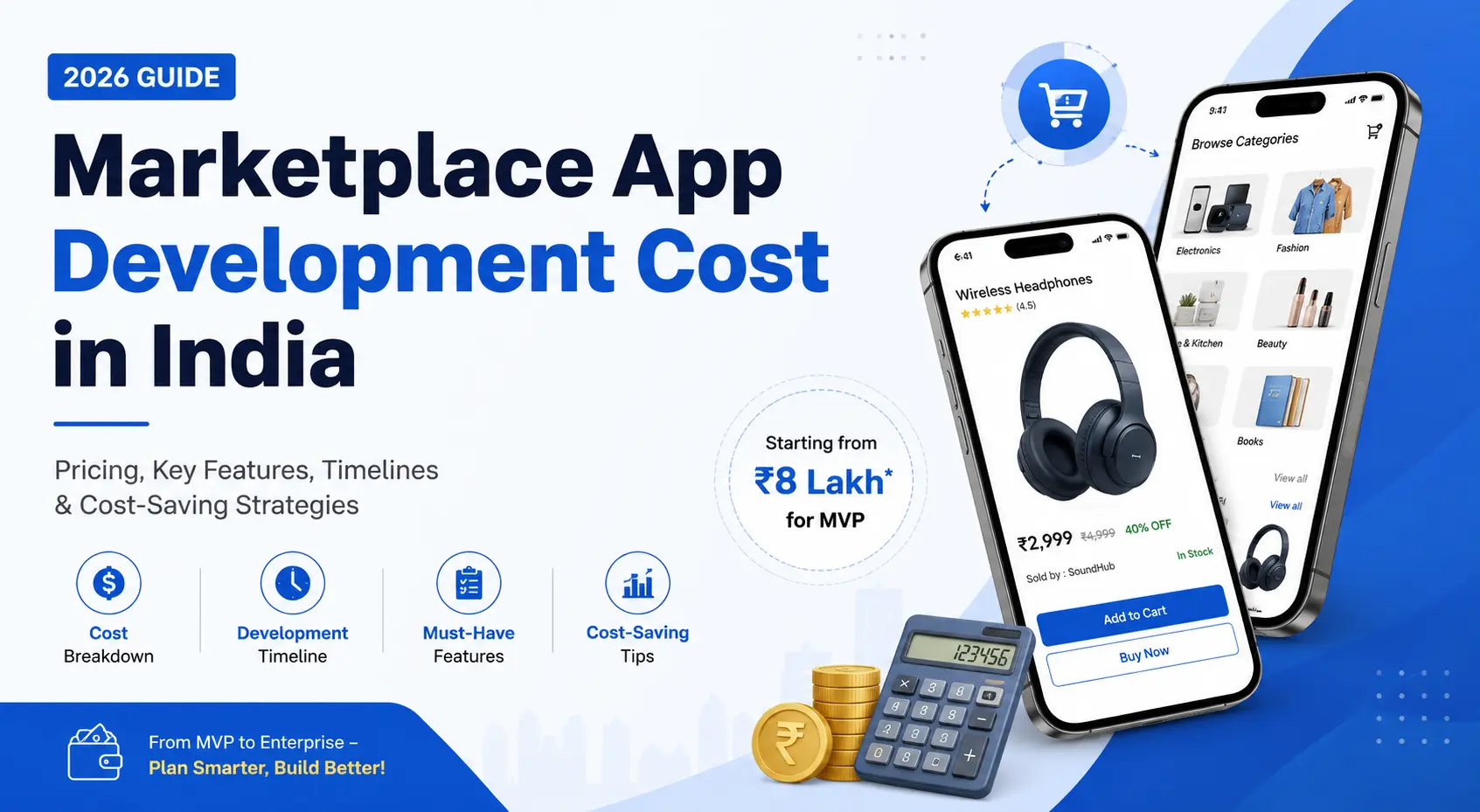
A multi-vendor marketplace is more complex than a standard ecommerce app because it has to manage buyers, sellers, administrators, payments, commissions, orders, and often logistics through the same platform. As a result, marketplace app development cost in India is generally higher than the cost of building a single-seller ecommerce application.
A focused marketplace MVP can start at around ₹8 lakh–₹18 lakh, while a standard multi-vendor marketplace may require approximately ₹15 lakh–₹35 lakh. Advanced platforms with AI, real-time delivery, complex payment workflows, multiple user roles, and enterprise infrastructure can cost ₹35 lakh–₹60 lakh or more.
The final cost depends on the marketplace model, number of user roles, platforms, features, backend architecture, integrations, security requirements, and scalability.
If you are also comparing the cost of building a regular mobile application, you can read our guide on mobile app development cost in India 2026, how much does it cost to build an ecommerce app in india. Before selecting a development partner, it is also useful to understand how to choose a mobile app development company in India.
Multi-Vendor Marketplace App Development Cost in India
A multi-vendor marketplace typically requires more functionality than an ecommerce application with a single seller. Instead of managing only customers and one business, the platform has to coordinate buyers, sellers, administrators, payments, commissions, listings, orders, and other operational workflows.
| Marketplace Type | Estimated Development Cost | Typical Timeline |
|---|---|---|
| Focused Marketplace MVP | ₹8–18 lakh | 10–14 weeks |
| Standard Multi-Vendor Marketplace | ₹15–35 lakh | 14–22 weeks |
| Advanced / Enterprise Marketplace | ₹35–60 lakh+ | 5–9 months+ |
These are planning estimates rather than fixed quotations. The actual cost can vary depending on the marketplace model, features, integrations, technology stack, UI/UX requirements, testing, and post-launch support.
Basic Multi-Vendor MVP
A focused marketplace MVP should include only the functionality required to validate the business model.
It could include:
- Customer interface
- Seller panel
- Admin panel
- Product or service listings
- Search
- Shopping cart or booking flow
- Payment integration
- Order or booking management
- Basic commission management
- Customer notifications
Starting with an MVP allows a business to test demand before investing in advanced marketplace functionality.
Advanced Multi-Vendor Marketplace
An advanced marketplace may include:
- Seller verification
- Seller analytics
- Split payments
- Delivery management
- Live order tracking
- Dispute management
- Loyalty programmes
- AI-powered recommendations
- Advanced reports
- Multiple locations
- Multi-language support
- Advanced commission management
- Seller payouts
- Real-time notifications
Every additional workflow increases the development, testing, integration, and maintenance effort.
How to Reduce Marketplace App Development Cost
You do not need to build every feature in the first version. A better approach is to launch a focused product, validate demand, and expand based on real customer and seller feedback.
Start With a Focused MVP
Start with a single city, category, or customer segment before expanding to multiple locations and industries.
This reduces the initial development scope and allows you to test whether the marketplace model works.
Prioritize the Core Transaction
Before investing in advanced features, make sure users can successfully complete the main marketplace journey:
Discover → Select → Pay/Book → Complete the Transaction
For example, a service marketplace should first make it easy for customers to find a provider, book a service, make a payment, and receive confirmation.
Use Cross-Platform Development Where Appropriate
Flutter and React Native allow businesses to develop Android and iOS applications using a shared codebase. This can reduce duplicated development work when a cross-platform approach is suitable for the project.
However, the technology should be selected according to performance, integrations, platform-specific requirements, scalability, and long-term maintenance—not simply because it is cheaper.
Use a Web Panel for Sellers
For inventory-heavy or B2B marketplaces, sellers may prefer a web-based dashboard for managing large product catalogues instead of performing every task through a mobile application.
A web seller panel can make bulk product management, inventory updates, order processing, and reporting more practical.
Integrate Existing Systems
If you already use an ERP, CRM, inventory system, payment infrastructure, or other business software, integrating those systems may be more efficient than rebuilding the same functionality from scratch.
Hidden Costs of a Marketplace App
The initial development quotation is not the complete cost of operating a marketplace.
Businesses should also consider:
- Cloud hosting
- Maps and location APIs
- SMS/OTP services
- WhatsApp messaging
- Payment gateway charges
- Email services
- Analytics tools
- App Store and Google Play accounts
- Security monitoring
- Bug fixes
- Maintenance
- Customer support
- Seller support
- Marketing
- Infrastructure scaling
As transaction volume increases, cloud infrastructure, API usage, messaging, maps, payment services, and other operational expenses can also increase. These costs should be considered when preparing the marketplace budget.
How Long Does It Take to Build a Marketplace App?
The development timeline depends on the number of user roles, features, integrations, platforms, backend complexity, testing requirements, and overall scope.
A focused marketplace MVP can take approximately 10–14 weeks.
A standard marketplace with multiple user roles, payment workflows, seller verification, and customized backend functionality can take around 14–22 weeks.
A complex marketplace with AI, real-time dispatch, multiple integrations, advanced analytics, or enterprise requirements can take 5–9 months or longer.
The Marketplace App Development Process
The development process typically includes:
- Business requirement analysis
- Marketplace workflow planning
- UI/UX design
- Backend architecture
- Customer-side development
- Seller-side development
- Admin panel development
- Payment integration
- Third-party API integration
- Testing and security
- Deployment
- Post-launch support
Do not choose a development company simply because it promises the shortest timeline. A marketplace has multiple connected user journeys, so proper testing is essential before launch.
Illustrative Case Study: Building a Marketplace With a ₹20 Lakh Budget
Note: This is an illustrative planning example, not a verified client case study.
Imagine a startup wants to build a local services marketplace for a single city with a budget of ₹20 lakh.
Instead of launching a nationwide platform immediately, the business could start with the following scope.
Customer Side
- Registration
- Service search
- Provider profiles
- Booking
- Online payments
- Reviews
- Notifications
Provider Side
- Registration
- Verification
- Service listings
- Availability management
- Booking management
- Earnings information
Admin
- User management
- Provider approval
- Commission management
- Booking management
- Payment management
- Reports
Advanced AI functionality, multi-city operations, sophisticated loyalty programmes, and large-scale automation can be introduced after the marketplace has validated demand.
The goal of the first version is to determine whether customers can easily find and book service providers while providers can generate business through the platform.
How to Choose a Marketplace App Development Company in India
Before hiring a development company, evaluate more than just the quoted price. The right partner should understand the technical and operational complexity of a two-sided marketplace.
Do They Understand Two-Sided Platforms?
Find out whether the company has experience with:
- Buyer and seller workflows
- Seller onboarding
- Commission systems
- Payment settlements
- Admin moderation
- Dispute management
- Order or booking workflows
Can They Explain the Technology?
The development company should clearly explain why it recommends Flutter, React Native, native development, or a particular backend architecture for your project.
The recommendation should consider performance, integrations, scalability, security, maintenance, and platform-specific requirements.
Have They Built Similar Platforms?
A company that has built ecommerce apps may not automatically have experience with complex marketplace platforms.
Ask for relevant examples involving:
- Multiple user roles
- Buyer and seller transactions
- Payment workflows
- Third-party integrations
- Similar scale
- Industry-specific workflows
Is the Admin Panel Included?
Do not evaluate a proposal based only on the customer-facing application.
An admin panel is essential for managing sellers, users, payments, listings, commissions, disputes, reports, and day-to-day marketplace operations.
What Happens After Launch?
Clarify the company's post-launch support policy, including:
- Bug-fix response time
- Maintenance
- Server management
- Security updates
- New features
- Third-party integrations
- App Store and Google Play support
Final Verdict
The marketplace app development cost in India depends on the number of users and roles, marketplace model, platforms, backend architecture, payment workflows, integrations, real-time functionality, security, and scalability requirements.
A focused marketplace MVP may require a budget of around ₹8 lakh–₹18 lakh. A standard marketplace can cost approximately ₹15 lakh–₹35 lakh, while advanced and enterprise platforms may require ₹35 lakh–₹60 lakh or more.
These are planning ranges rather than fixed quotations because every marketplace has different technical and operational requirements.
The most effective strategy is to launch with the core marketplace transaction, validate demand, and then invest in advanced features as the platform grows.
An effective marketplace is more than an app that connects buyers and sellers. It is a complete ecosystem that requires stable technology, seamless workflows, secure transactions, efficient seller management, and strong operational controls.